


UNDERSTANDING HEGEL 15
OR: NO MORE THESIS — ANTITHESIS — SYNTHESIS
Win Corduan
Part 15 The Wings of Hegel and Pantheism

| This is definitely not the last entry on "Understanding Hegel. " The faucet is flowing and, as long as in my estimation the water is potable (no, that does not mean you can carry it), I can't bring myself to shut it off, and I think I will be able to judge when I'm scraping too much to continue with Hegel. |
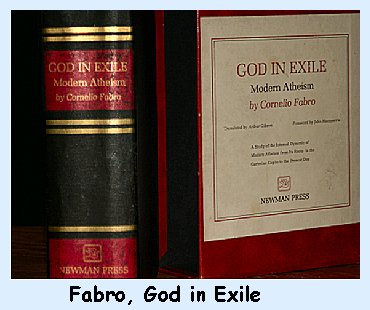 Nor does it make a lot of sense to call Hegel an atheist in the most common understanding of the term, namely as someone who rejects the existence of any God or Supreme Being whatsoever. To be sure, there is another way of using the term "atheist," namely literally as the denial of classical or biblical theism, so that it stands for a- theism in that specific sense. Cornelio Fabro has built his masterpiece, God in Exile: Modern Atheism, around that latter definition. He defines atheism as the "displacement of transcendence by immanence," and, given that definition, Hegel fits the category perfectly. Think about it: A "transcendental" idealism, viz. one that locates the content of knowledge in the mind by transcendental deduction, is paradoxically the epitome of an immanentist philosophy. Nevertheless, even though I thoroughly endorse Fabro's work and conclusions, there is also often a need for greater specificity as to the nature of a non-theistic world view, and then "panentheism" is more appropriate than "pantheism."
This short book attempted to demonstrate that Hegel's philosophy was thoroughly anti-God, anti-religion, and anti-establishment by going through his system point-by-point. The philosophical reading public, those who agreed with it as well as those who did not, interpreted it as a sharp rebuke of Hegel and a denunciation of all of Hegel's followers who blindly attempted to understand Hegel in a more conservative fashion. All the evidence against him was there in print. If your own theology is conservative and biblical, and you want an inventory of everything that's wrong with Hegel, consult the Trumpet.
The Trumpet is a good representation of the fact that after his death, Hegel's followers had divided into two camps, the "Right Wing Hegelians" and the "Left Wing Hegelians." The terminology is due to David Strauss who had studied Hegel's philosophy before moving to Berlin, where he studied under the theologian Friedrich Schleiermacher. Hegel and Schleiermacher were opponents intellectually and personally. They deliberately scheduled their lectures at the same time every day, so that students had to choose between one or the other.
| Arthur Schopenhauer (1788-1860), who eventually became famous (or maybe notorious) was seeking a position at Berlin in 1819. He had not yet begun his habilitation dissertation (a requirement to teach at a university), but it was Hegel who gave him a dispensation and allowed him to get by with just one lecture. Schopenhauer was convinced of the superiority of his philosophy to the transcendental idealists and scheduled his lectures for the time already claimed by Hegel and Schleiermacher. In contrast to Hegel in his early years at Jena, Schopenhauer was not content to teach just a handful of students at a time and cancelled his class every semester. In his informal conversations and his subsequent writings, he consistently blamed Hegel in offensive terminology for his lack of success at Berlin. |
Because of David Strauss' earlier association with Hegel, he has frequently been mislabeled as a Hegelian theologian (including by your present author) and, even though one can find Hegelian conceptualizations in Strauss' work, when controversies concerning Hegel arose, he eventually declared himself to be non-Hegelian. He is probably best known for his work on Jesus.
|
Strauss's Life of Jesus, sought to establish a historically credible picture of Jesus, devoid of all supernatural attributes, a major initiative in the never-ending so-called quest for the historical Jesus, which has always meant the "quest for a Jesus without miracles." These quests are by their very nature condemned to be unsuccessful, except in the eyes of their their authors.
|
The Right Wing Hegelians were those who interpreted Hegel as supporting theism and a basic Christian orthodoxy, even if it was expressed in flamboyant philosophical terminology. Left Wing Hegelians, who are by far the better known of the two groups, claimed theology had been overcome, and that, consequently, Hegel's philosophy is ultimately atheistic. The Left Wing Hegelians, such as Ludwig Feuerbach (1804 -1872) and Karl Marx (1818-1883), then sought to extend this atheism further in their own systems.
As a matter of historical fact, there should be little question as to which side of this posthumous debate Hegel himself would have defended. He already expressed his point of view without equivocation during his life time. A theologian named Karl Friedrich Goeschel (1784-1861) lived in Berlin at the same time as Hegel, and even though they were mutually supportive of each other, they never met in person, most likely because Hegel spent much of his last year (1830-31) outside of Berlin, evading a cholera epidemic, but dying shortly after returning to Berlin of a different ailment. 
Goeschel wrote a book called Aphorismen Über Nichtwissen und Absolutes Wissen, this title being traditionally translated as Aphorisms on Ignorance and Absolute Knowing, which is technically accurate, but totally takes the fun out of it. The spirit of the piece is actually captured with something along the line of "Aphorisms on those who think they know everything but don't know anything." [Help! I'm beginning to think I'm Walter Kaufmann again . . .!] In this book, Goeschel writes from a Right Wing Hegelian perspective against the Left Wing Hegelians. Among his points is that the pronouncements of the Left Wing Hegelians are frequently entirely tautological or platitudinous, so that, after someone has expressed them, there is nothing left to say other than perhaps, "Supper is served," or some similar inanity so as to break the awkward silence.
Goeschel is considered by many to be the ultimate instantiation of a Right Wing Hegelian. And thus we come to the point: In 1830 Hegel published a review of Goeschel's book, in which he thoroughly endorsed Goeschel's perspective. Hegel considered himself to be an orthodox Lutheran and, as odd as it might sound, we probably need to count Hegel himself among the Right Wing Hegelians.
Hegel made it very clear that, in distinction to many of the leading intellectuals of his day, he was not only a Christian, but a Lutheran Protestant Christian. This matter came to a head one day. Franz Wiedemann tell us in his biography of Hegel that there was a priest from a nearby Catholic church who for a time attended Hegel's lectures. His presence did not affect Hegel's choice of material, and in the process of supposedly describing the difference between Protestantism and Catholicism, Hegel opined that, if the host (wafer) used in the Catholic mass is truly turned into the body of Christ, then, if a mouse happens to nibble on a piece of it, everyone should bow down to it. I'm astounded that Hegel apparently thought that this illustration was either witty or cogent; it was a rather juvenile and uninformed attempt at humor. The Catholic auditor was incensed and lodged an official complaint about Hegel's indiscretion. Hegel responded:
| That, if a complaint is entered about statements that I made from the cathedra before Catholic spectators and that caused them offence, they must either complain against themselves for attending philosophical lectures given at a Protestant university by a professor who glories in having been baptized and brought up a Lutheran, who is and will remain one; or else they can blame their superiors who failed to warn them, or, as was the case with the Catholic theology students, to forbid them to attend. |
Daniel Lindquist, a prolific author on Hegel, provides some fascinating insights on Hegel, which I first encountered in a blogpost of 2008 . His observation in the context of the debate on Hegel's own position is not surprising, given the fact that the evidence seems to me to be unequivocal:
| It's become clear to me that many of Hegel's interpreters simply want him to not be a Lutheran. For if they regard themselves as Hegelians, they don't want to be seen as endorsing Christianity (or religion generally -- certainly not any sort of orthodox Protestantism); if they regard themselves as anti-Hegelians, they don't want to be seen as opposing Christian thought. |
Excellent insight! Hegel thought of himself as a Lutheran Protestant in line with what later became Right Wing Hegelianism, though obviously without the label, and (Karl Rahner, John Hick,and Sigmund Freud notwithstanding), even though it is very possible that a person may be mistaken about the label of their beliefs, I don't think that they can be in error on what they actually believe.
But now, the question of what's up with the Trumpet of Judgment over Hegel becomes even more urgent. Did Hegel express a philosophical system of which he himself was ignorant? As we just said, that shot is not on the board. I need to reiterate that one could be mistaken about the further implications of what one believes, but to use that maneuver to declare that a person does not believe what he thinks he believes, as opposed to his simply being inconsistent, is highly precarious and should best be attempted only by highly trained Freudians or professional mind readers. But then, why take him to task for something that he himself abjured? Why accuse him of an unacceptable line of thought when, on his own testimony, that was not his line of thought?
Well, Lindquist has given us a good leg up in trying to understand what may have been the case. He stated in so many words that depicting Hegel as non-Christian or non-theist has served frequently as a legitimation for one's own point of view, either by claiming him and, thereby distancing oneself from Christianity, or by renouncing him so that one's affinity to Christianity is immune from being tainted by Hegel's philosophy.
If there is a weakness in this deontic constructive dilemma, it is that it only works on the assumption that "Right Wing Hegelians," such as Goeschel, who appealed to Hegel in their support of Christianity, have had a negligible effect on how Hegel has been interpreted later on. Like it or not, that assumption did become a fact of history. So, say that the "Trumpet" is an instance of interpreting Hegel to suit one's assumptions. Specifically, then, here we would have an anonymous non-Hegelian theistic writer vituperating Hegel for being a heretic, thereby making it crystal-clear to the world that this critic's own philosophy is free of Hegelian encroachments.
However, that line of thought, though a good appraisal of what happened in the course of the history of philosophy after Hegel, cannot apply to a point in time that close to Hegel's death. After all, there were Goeschel and his fellow Right Wing Hegelians. They are visibly alive and they are appealing to Hegel in favor of their conservative Christian views. They certainly did not denounce Hegel as pantheist or atheist, and their work, even if not convincing to non-Hegelian conservatives, would at least demonstrate that there is no logical necessity to divorce Hegel from Christianity.
So, let's think creatively here for a moment. The following idea may at first strike you as improbable and implausible, but:
What if the "Trumpet" had actually been written by a Left Wing Hegelian?
Then it could be a satire on the Right Wing Hegelians and non-Hegelians which might even be used in support of the Left Wing view.
Too far-fetched, you say? As a matter of fact, this highly unusual scenario is what actually took place.
I mentioned that the author of this pamphlet was at first unknown, but it came out eventually that it was written by a theology professor named Bruno Bauer (1809-1882) in Bonn, the beloved city of my earlier youth, together with his protegé Karl Marx.
