


UNDERSTANDING HEGEL 21
OR: NO MORE THESIS — ANTITHESIS — SYNTHESIS
Win Corduan
What follows is an informal bibliography with comments and evaluations. As everyone knows, my scholarly pursuits have led me in different directions since I wrote my Ph.D. dissertation on "Elements of the Transcendental Method of G. W. F. Hegel in the Theology of Karl Rahner" (Rice University, 1977). At the time, there were few books on Hegel in print in English, and a new appraisal of Hegel was still in its early stages; his major books had been translated into English, but frequently manifested dubious subtexts. Today there are exponentially more books and articles on Hegel, though I'm not entirely certain that the situation concerning the accuracy of the translations is all that much better. What follows is a personal bibliography that may be a bit out-dated going back to my days in grad school at Rice. It includes a number of books that have been helpful to me, but which would not necessarily be found in other listings. But that's okay. This is neither a competition nor an exercise in copying one list of books from another. For example, there is a good bibliography attached to the article on Hegel in the Stanford Encyclopedia of Philosophy, and I urge you to consult it. Here's mine:
Hegel's Works
How many books did Hegel write? In German, there are two collections: the shorter Suhrkamp edition has twenty volumes. The Meiner edition, not yet finished, will have more than that. But the true answer is actually "four."
- The Phenomenology of Spirit,
- The Science of Logic,
- The Encyclopedia of Philosophical Sciences,
- The Philosophy of Right.
 Works such as the History of Philosophy or the Philosophy of Religion are based on the lecture notes from quite a few students, assembled by his son Carl. We can be sure that they reflect what Hegel said in his lectures, particularly since his style was slow and ponderous, giving the students ample time to copy his utterances, but Hegel did not publish those books. Also, in some cases the work takes up three volumes where one might suffice. This is true, for example, for the Encyclopedia. The reason is that its content has been greatly expanded by supplements from the students' notes. So, at present we have two collections of all of his writings in German:
- Gesammelte Werke, Rheinisch-Westfälische Akademie der Wissenschaften, ed., Hamburg: Felix Meiner Verlag, 1968. This series represents the restart of a restart. It originated prior to World War II, when Felix Meiner still published books in Leipzig, which became a part of "East Germany." After the war, he was able to pick up the pieces in Hamburg, but then his successors decided to start afresh with a complete critical edition. ("Critical" here means making double-sure of the accuracy of the text and being aware of possible significant variations in printed editions or even manuscripts.
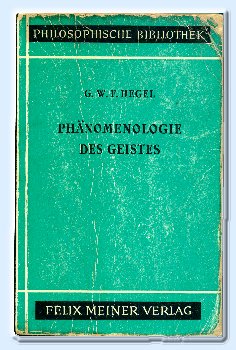
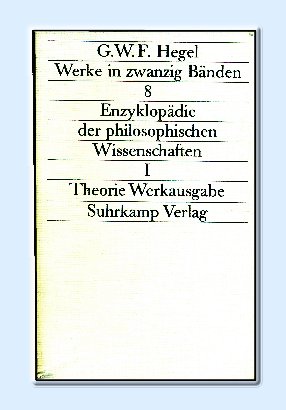
- Werke in zwanzig Bänden, Moldenhauer, Eva and Michel, Karl Markus, ed., Frankfurt am Main: Suhrkamp Verlag, 1971. The difference to the Meiner edition is primarily that this collection is not "critical." However, it is much less expensive, sufficiently accurate for any but the most refined purposes, and has served me well, though my copy of the Phenomenology comes from the 1952 Meiner collection.
 As indicated above, the translations into English still appear to me to be sporadic and uneven. I won't make reference to all of them.
- Phenomenology of Spirit, trans. A. V. Miller, Oxford: Oxford University Press, 1977. At this point, this seems to be the preferable one of the various translations, but I have been surprised by Miller's phrasings quite a few times.
- Hegel's Science of Logic, trans. A. V. Miller, London: Allen and Unwin, 1969.
- Elements of the Philosophy of Right, ed. Allen W. Wood, trans. H. B. Nisbet, Cambridge: Cambridge University Press, 1991.
- The Encyclopedia has been translated and published in three parts: Logic, Nature, Spirit (Mind).
- The Encyclopedia Logic: Part 1 of the Encyclopaedia of Philosophical Sciences, trans. T. F. Geraets, W. A. Suchting, and H. S. Harris, Indianapolis: Hackett, 1991.
- Philosophy of Nature (Part Three [sic!] of the Encyclopaedia of Philosophical Sciences), trans. Michael John Perry, 3 vols, London: George Allen and Unwin, 1970.
- Hegel's Philosophy of Mind: Being Part Three of the Encyclopaedia of Philosophical Sciences, trans. William Wallace, Oxford: Clarendon Press, 1971.
I assume that under Philosophy of Nature, the "Three" is supposed to be "Two."
Biographies of Hegel
In 1844 Johann Karl Friedrich Rosenkranz published a thorough biography of Hegel in German. More accessible to us today:
- Walter Kaufmann, Hegel: A Reinterpretation. Garden City, N.Y: Doubleday Anchor, 1966. This book had a great amount of impact on the study of Hegel in the English-speaking world because Kaufmann had a broad, popular appeal, and his voice denouncing the interpretation of Hegel along the lines of dry, logical schemata was heard. The book contains a collection of Hegel's letters. Its original hardback version also included a new translation of the preface to the Phenomenology, but when the paperback version came out, it was published simultaneously, but separately, under the title of Hegel: Texts and Commentary. Kaufmann's book is a somewhat rhapsodic treatment of Hegel. Having found liberation from the chains of formalism imposed on Hegel by the British idealists, thanks to the German scholar, R. Kroner, he resolutely refused to let Hegel be bound anew by anything systematic. Allusions to the intellectual world surrounding Hegel abound, but there is no attempt to establish a principle of coherence in Hegel.
- Franz Wiedmann, Hegel: An Illustrated Biography, trans. Joachim Neugroschel. N.Y.: Pegasus, 1968. A short, readable study that is not exceptionally philosophically oriented, but provides far more details than Kaufmann's book.
Secondary Works
I've already mentioned my own few contributions.
- T. Stace, The Philosophy of Hegel. N.Y.: MacMillan, 1924. An overview of Hegel's system, as distilled by the cream of British scholarship. It even includes a fold-out chart, sized ca. 20" x 14", depicting the entire system (essentially a collation of the table of contents of the Encyclopedia).
- J. N. Findlay, The Philosophy of Hegel: An Introduction and Re-examination. N.Y.: Collier, 1958. A new understanding of Hegel for sure. Influenced by Findlay's links to theosophy. He modified his interpretation somewhat in the article that we shall list below.
- Hans Küng, Menschwerdung Gottes: Eine Einführung in Hegels Theologisches Denken als Prolegomena zu einer künftigen Christologie. (Freiburg: Herder, 1970). ("The Incarnation of God: An Introduction to Hegel's Theological Thought as Prolegomena to any future Christology"). A detailed study by the famous Roman Catholic theologian of Hegel's philosophy. Its object is to make the case that a static view of God as immutable and impassible needs to be replaced by a view of God as responsive and changing, which Küng sees in Hegel.
- Hegel: A Collection of Critical Essays, ed. Alasdair MacIntyre (Garden City, N.Y.: Doubleday Anchor 1972). This anthology of articles spans the spectrum of views on Hegel, but it includes some of the most important pieces on Hegel written in the last century. The following are the essays in this collection:
- J. N. Findlay, "The Contemporary Relevance of Hegel." In this essay, Findlay backs off from his earlier, almost purely intuitive, view of Hegel's system and takes steps in the direction of a transcendental reading of Hegel.
- Walter Kaufmann, "The Hegel Myth and Its Method." Kaufmann's refutation and indictment of Karl Popper's treatment of Hegel in The Open Society and Its Enemies. Must Reading!
- Walter Kaufmann, "The Young Hegel and Religion." Why did Kaufmann get two essays in this book? I'm puzzled because I'm not sure I really understand what Kaufmann was trying to prove in this article, other than that Hegel progressed to a position where he gave philosophy a higher place than religion.
- Klaus Hartmann, "Hegel: A Non-Metaphysical View." A strong defense of the transcendental ("categorical") understanding of Hegel. Almost too strong; Hartmann insists on the connection between the "categories" of the system and reality, but he does not seem to be entirely convincing. In fact, I would suggest that the transcendental view of Hegel is best defended by admitting its liability, viz. the gap between the transcendental system and being. One cannot develop a metaphysics from anti-metaphysical premises. Must Reading!
- R. C. Solomon, "Hegel's Concept of Geist." An essay that seems almost pedestrian for the first few pages and then grabs you, making the strongest case for the transcendental approach to Hegel yet. Must Reading!
- Charles Taylor, "The Opening Arguments of the Phenomenology." Taylor is comfortable with a transcendental approach to philosophy (and aware of its potential shortcomings), which turns this article into a very helpful tour of the beginning of the Phenomenology. Must Reading!
- George Armstrong Kelly, "Notes on Hegel's 'Lordship and Bondage.'" As I said much earlier in this series, it is a huge mistake to take Hegel's parables (such as "master" and "slave"), which actually merely illustrate epistemological concerns, into essays in sociology. Nevertheless, the idea that the slave has more freedom than the master has been irresistible as a separate topic for myriads of writers, most prominently Marxists. This metaphor is certainly a clever idea on an important topic, but we should not read this segment of Hegel's Phenomenology as though it were intended to be primarily an essay on this important topic rather than a catchy illustration. Kelly cannot quite decide which reading is preferable: the systematic transcendental one or the social commentary one.
 Alasdair MacIntyre, "Hegel on Faces and Skulls." MacIntyre wades into Hegel's treatment of the alleged science of phrenology, an important discipline in his day.
- Michael Kosok, "The Formalization of Hegel's Dialectical Logic." A most ingenious article, applying symbolic logic to Hegel's method of negation, developed in great detail and at great length. Very interesting to follow Kosok's innovations. Downright brilliant! Unfortunately completely off the mark in terms of Hegel's actual method. A throwback to the days when philosophers, such as McTaggart, assumed that Hegel had a unique formal logic, completely out of sync with a transcendental approach.
- Richard L. Schacht, "Hegel on Freedom." A good example of how to use an unwarranted (metaphysical) approach to Hegel, and still come out with something very good and positive. Argues against Hegel's supposed support of totalitarianism.
- Shlomo Avineri, "Hegel Revisited." Methodology is irrelevant in this essay since it deals with Hegel's legacy, particularly his appropriation for various philosophical views. Shows how the mature Hegel, rightly or wrongly, thought of Prussia as a constitutional monarchy, a view that was held against him by both conservatives and liberals subsequently . In this essay Avineri alludes to how great a role anti-Semitism played in politics during Hegel's time, both inside and outside of the academy, with Hegel going out on a limb by rejecting this form of prejudice.
